American national holiday commemorating the birth of Dr. Martin Luther King Jr.
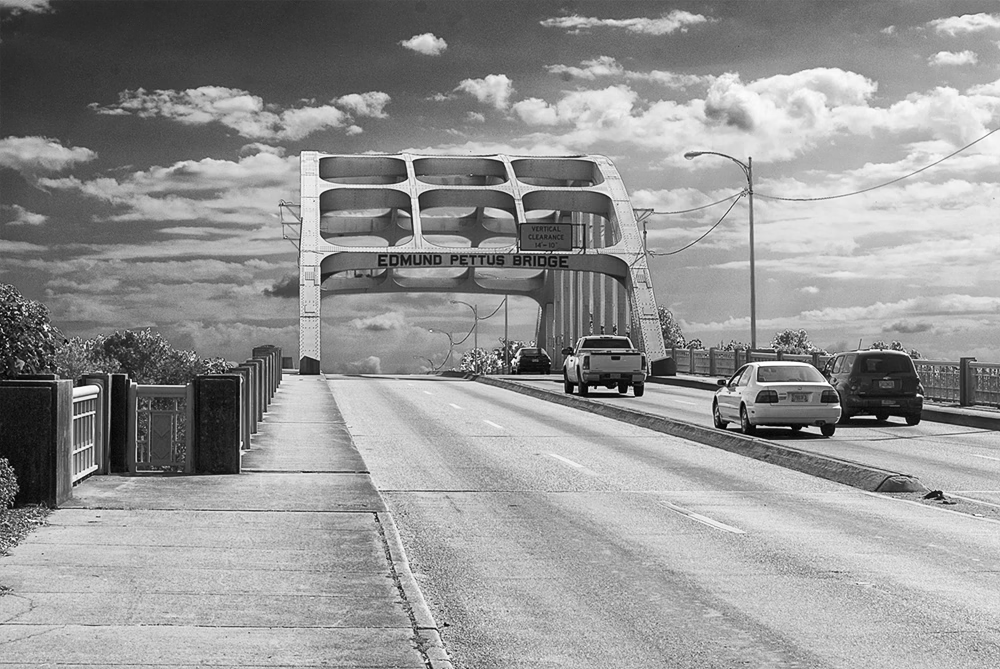
Edmund Pettus Bridge, US Route 80, Selma, Alabama, site of Bloody Sunday, March 7, 1965. Copyright © 2023 NSL Photography. All rights reserved.
Today in America we remember the life of the Reverend Dr. Martin Luther King Jr. Speaking about Dr. King’s legacy, when signing the bill into law making Dr. King’s birthday a national holiday, his widow Coretta Scott King reminded everyone that Dr. King was the “Commander in Chief Nonviolent Commander.” He talked about what he stood for and how he worked, saying,
“His non-violent campaigns brought liberation, reconciliation and justice. He taught us that only peaceful means can bring peaceful ends; our goal was to create a community of love.”
The MLK holiday is unique.
Of all America’s holidays, the one celebrated in Dr. King’s honor is unique. It has become a national day of service. Across the country, following the lead of Philadelphia, Pennsylvania, where the first “Martin Luther King Day of Service” was held, millions of volunteers are now “turning their community concerns into volunteer service and ongoing civic action on King Day and beyond.”
After participating in the “Day of Service,” I believe those who may not know much about Dr. King’s life might consider traveling in the coming months to explore historic sites that can help bring Dr. King’s past to life and learn how his short but significant life impacted the lives of millions of Americans. It is an exploration that can add perspective to past events and help us gain a better understanding of important American history and its significance in the present day.
For those Americans who lived through Dr. King’s short life, the visit may bring back important memories. I will never forget August 28, 1963. Summer was coming to an end and there were just a few days left before the start of the school year. I was standing among many people in front of the Lincoln Memorial listening to the “I Have a Dream” speech, one of the greatest speeches of the 20th century. The impact of that day can never be minimized or ignored.
The first stop on my MLK tour was King’s birthplace in Atlanta, Georgia.
A few years ago we (my wife and I) started our King journey in his birthplace, Atlanta.
Martin Luther King’s family home. Copyright © 2011 NSL Photography. All rights reserved.
We visited the King family home where Dr. King was born. He grew up there with his older sister, Willie, and his younger brother, Alfred, until 1941. The house is a modest middle-class wood frame structure.
It stands as it did when the king lived there with his family. The house can only be visited through a National Park Service ranger tour. Upon visiting the house, you begin to realize the king’s growth towards adulthood.
The house is part of the Martin Luther King Jr. National Historic Site. The site includes several buildings: the Visitor Center, the historic Ebenezer Baptist Church, the King Center, the World Peace Rose Garden, the King’s Tomb, as well as the King childhood home. The National Park Service has also acquired the home in the Vine City neighborhood that Dr. King and his wife used in the three years before his assassination. It is not open to the public yet.
Just a block and a half from King’s birthplace, walking down Auburn Avenue, you’ll find the historic Ebenezer Baptist Church.
From King’s birthplace, it’s a short walk to the historic Ebenezer Baptist Church where both King and his father before him were pastors.
Martin Luther King Sr. became the leader of Ebenezer Baptist Church in 1931, when America was in the midst of the Great Depression, when King Jr. was just two years old. Despite the recession, King Sr. organized membership and fundraising drives that helped the struggling church flourish. King Sr. fought for equal justice and civil rights throughout his pastoral life. In 1960, Dr. King joined his father as co-pastor of Ebenezer.
After the murder of his son Martin in 1968 and the accidental drowning of son Alfred a year later, King Sr. faced the murder of his wife Alberta in 1974 while she sat at the organ at Ebenezer. King Sr. retired the following year.
Selma, Alabama, and the bridge.
From Atlanta, we traveled to Selma, Alabama, the site of “Bloody Sunday” in March 1965 and the starting point of the Selma to Montgomery protest march.
Brown Chapel AME Church, Selma, Alabama Copyright © 2011 NSL Photography. All rights reserved.
In Selma, we went to Brown Chapel AME Church. The church was the meeting place for the march. On March 7, 1965, approximately 600 civil rights marchers began their march from the church, led by the Reverends Hosea Williams and John Lewis. As they crossed the Edmund Pettus Bridge, they encountered a wall of state troopers and a county posse, who brutally attacked the marchers with tear gas and nightsticks. It was called “Bloody Sunday” and images of the attack were broadcast around the world. Images of Amelia Boynton, beaten until she was unconscious; 14-year-old Linda Lowry, covered in blood, needed more than 30 stitches; And John Lewis was seen around the world with a fractured skull.
In Selma, Alabama, we walked across the Edmund Pettus Bridge, the site of “Bloody Sunday.”
We then walked across the Edmund Pettus Bridge itself, which, while empty save for a few cars, was a powerful image recalling a history of cruelty and inhumanity.
From Selma we headed to Montgomery, Alabama. There we visited Dexter Avenue King Memorial Baptist Church, just a few blocks from the Alabama State Capitol Building. King became pastor of Dexter Avenue Church in 1954 at the age of 25.
Just a year later, the Montgomery Bus Boycott began, led by King and others, after Rosa Parks was arrested for refusing to give up her seat on a Montgomery city bus. The boycott lasted more than a year, and during this time King’s home was bombed. King was arrested along with other leaders during the boycott.
In Montgomery, Alabama, after visiting Dexter Avenue King Memorial Baptist Church, we headed to the Civil Rights Memorial.
King continued to preach nonviolent action for civil rights and justice from the pulpit of the Dexter Avenue Church when in 1957 he and others, including Ralph Abernathy, founded the Southern Christian Leadership Conference. He continued fighting for civil rights in Birmingham, Selma, St. Augustine and across America until his assassination.
Behind the Dexter Avenue Church, you’ll find the Southern Poverty Law Center and the Civil Rights Memorial Center. The center features exhibits about the Civil Rights Movement, a small theater, and classrooms.
Southern Poverty Law Center Civil Rights Memorial Copyright © 2011 NSL Photography. All rights reserved.
Opposite the center is the Civil Rights Memorial, designed by Maya Lin, who designed the Vietnam Veterans Memorial. The memorial honors the achievements and memory of those killed during the Civil Rights Movement, from the Supreme Court decision of Brown v. Board of Education in 1954 to the assassination of Dr. King in 1968.
The black granite table in the center of the memorial records the names of those killed during the movement, and also records its history. Water comes out of its center, flows over its top and down its sides, reminiscent of Dr. King’s statement from Amos 5:24,
“…we will not be satisfied until justice rolls down like waters and righteousness like a mighty stream.”
It is worth the trip!
(Images provided by NSL Photography and are copyright. All rights reserved.)
Also read:
Mobility-Friendly Travel Guide from the National Council on Aging
How to File Small Claims Court for Airline Disputes
After working for several years in corporate America as a chemical engineer, executive, and eventually CFO of a multinational manufacturer, Ned founded a technical consulting company and later restarted his photography business, NSL Photography. Before entering the corporate world, Ned worked as a public health engineer for the Philadelphia Department of Public Health. As a renowned corporate, travel and wildlife photographer, Ned writes about travel and photography around the world, as well as runs photography workshops, seminars and photowalks. Visit Ned’s photography blog and gallery.