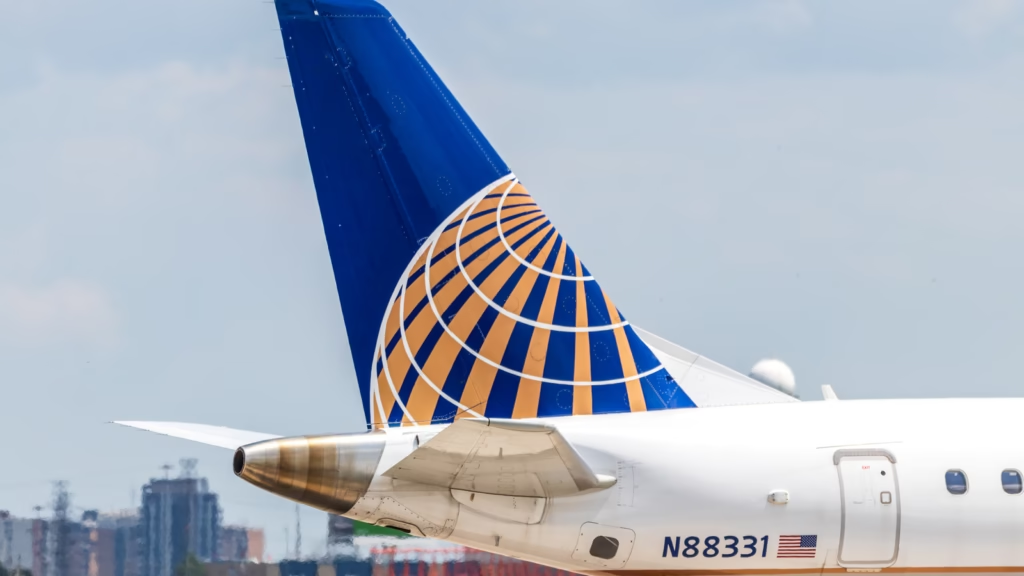
United Airlines has just announced 14 new routes, primarily domestic options in the United States. However, its two new seasonal flights will operate between the US and Canada for the spring and summer travel period.
The carrier’s decision to launch two new Canada-US routes could represent a bold move, especially at a time when the number of Canadians traveling to the United States continues to decline rapidly, with no clear signs of improvement following their lengthy US travel boycott that has been in place since the beginning of 2025.
United adds new Canada-US routes despite decline in Canadian travel demand
Despite a decline in Canadian travel to the US due to Canada’s travel boycott of the US, United Airlines has confirmed that it will launch two new routes that will fly between the two countries.
United will operate nonstop service between Washington Dulles International Airport (IAD) and Halifax Stanfield International Airport (YHZ) It will also run a new route between May 23 and September 19. Washington Dulles and Quebec City Jean Lesage International Airport (YQB) From 23 May to 24 October. Both routes will remain operational during peak travel months.
The routes were first announced on Instagram by Patrick Quayle, United’s senior vice president of Global Network Planning and Alliances.
The carrier’s announcement comes at a time when cross-border travel patterns between Canada and the US are becoming less predictable, raising questions about where United is betting with this bold expansion.
United’s new US-Canada routes could be risky amid low demand for US travel
Canadian travel to the United States has declined significantly over the past year. Many Canadian travelers are opting for destinations like Mexico and Europe instead of the US amid tensions that initially arose after President Donald Trump’s tariffs on Canada and his suggestion that Canada should become America’s “51st state”.
This change is reflected in official tourism statistics. Canadian travelers will account for approximately 28% of all international visitors to the United States in 2024. However, US Travel Association data shows that share has fallen to about 23% from January to October 2025, indicating a meaningful decline in inbound travel from Canada.
This leaves a question: Why would United make such a bold move that could be risky during Canada’s U.S. travel boycott?
What is United Airlines betting on with its new US-Canada routes?
The airline’s bold decision may be strategic; It could position itself to benefit if cross-border travel sentiment improves in 2026. Also, these new US-Canada routes are limited to the summer, which enables United to test demand while reducing long-term risk should demand for Canadians travel to the US not improve.
Ultimately, the airline is strengthening its network connectivity, while maintaining a presence in the Canada-US market during select months – the latter being an ideal time to test the strength of Canadians’ intent to visit the US in 2026. But will this be a successful option? Canadians’ online sentiment suggests that it may be difficult to get them back into their previous US travel habits.
Canadian online sentiment mirrors declining US travel trends
Beyond formal tourism data, Canadians’ travel discussions on social media and online forums suggest that the decline in U.S. travel goes beyond seasonal fluctuations.
For example, in a recent Reddit discussion posted on January 14, 2026, users debated what some described as a growing reluctance among Canadians to travel to the US, with many Canadian commenters saying that friends and family were choosing to vacation domestically or visit other international destinations instead.
Some users also pointed to changes in long-standing snowbird communities. One commentator noted that some Canadians traveling to the US in 2025 did so not for leisure, but to sell property, close US bank accounts and finalize financial matters (this has been a notable trend in states like Arizona and Florida, where more Canadian snowbirds are selling their second homes and investing their money back in Canada).
Others in the comments section also mentioned the high expenses for traveling to the US. An example of this, according to one user, is the new high cost to visit US national parks.
The user wrote, “I live in Alberta and have visited Montana a lot, it’s beautiful. There are plenty of hikes in Glacier that I would love to add to my list, but between the general conditions there and the new fee of US$100 per person to visit the park, I will be exploring closer to home in the near future.”
In fact, by January 1, 2026, Canadians will have to pay triple the cost to visit America’s 11 most popular national parks, like all other international tourists.
Other common reasons for avoiding US travel include uncertainty at the border; Some Canadians are concerned about new fees to enter the US, new rules such as fingerprinting and biometrics, which some experts argue are a violation of Canadians’ constitutional protections.
Together, these types of discussions reinforce widespread reporting that Canadian travel to the US is no longer as consistent as it used to be. That’s why airlines like United may consider adding a Canada-US route risky.
Overall, for US travelers, United’s new routes provide additional nonstop options to Eastern Canada, which can reduce travel time by avoiding connections through larger hubs. They also provide greater access to their southern neighbor for Canadians who are not boycotting the US. Increased competition on these routes could lead to lower fares for both Americans and Canadians during the summer.
Still, it will be interesting to see whether United’s gamble pays off. Ultimately, the performance of these new routes will provide insight into whether Canadian travel to the United States has stabilized. As the busy spring and summer travel seasons approach, booking trends will indicate whether United’s expansion is keeping pace with traveler demand or whether ongoing changes in cross-border travel behavior will continue to reshape the movement of Canadians and Americans between the two countries.