Electronic jamming and missiles are two risks identified by US regulators.
Major airlines canceled flights from Bogota to Caracas this week after US regulators warned of “increased military activity” around Venezuela.
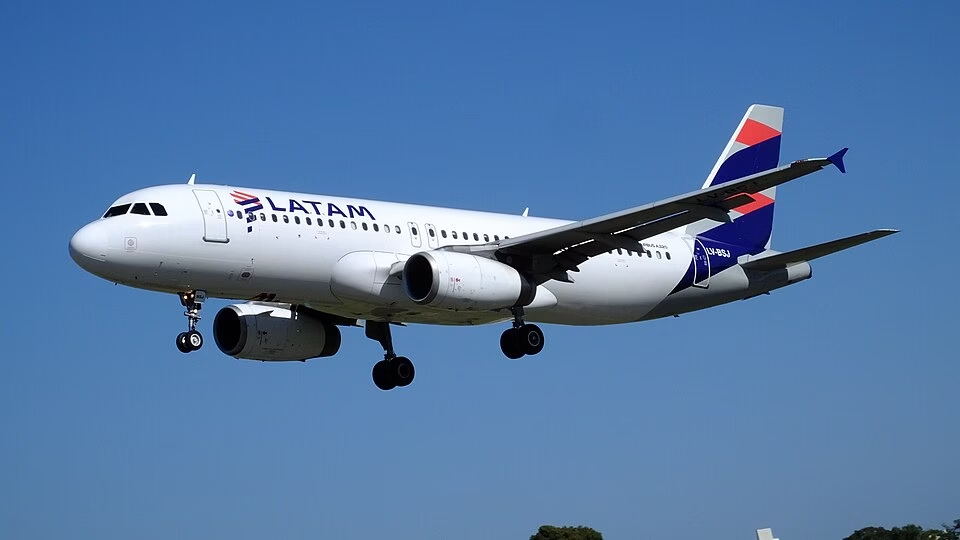
As a response to the Federal Aviation Authority NOTAM (Notice to Airmen), Avianca and LATAM, along with at least five other airlines, suspended flights through Venezuelan airspace that reported “Global Navigation Satellite System (GNSS) interference” around Macatea “Simón Bolivar” International Airport, which serves nearby Caracas.
The warnings were linked to ongoing military exercises in Venezuela, a response to large-scale U.S. military threats in the Caribbean region and air strikes on suspected drug boats, some of which originated from Venezuelan waters.
Colombia’s own airline regulator, Aeronautica Civil de Colombia, Reiterated the FAA’s warning but said air operators in Colombia could make “autonomous decisions” on flights to Venezuela.
On Monday several airlines were continuing direct flights from Bogotá, such as Wingo, Avior (a Venezuelan airline) and Satena (a commercial airline linked to the Colombian Defense Ministry). Copa offered connections via Panama.
mobile missiles
The list of airlines suspending flights continued to grow on Monday night, with TAP, Turkish Airlines, Iberia and GOL joined by Air Europa and Plus Ultra.
This came despite Venezuelan opposition Instituto National D Aeronautica Civil (INAC) In which airlines were threatened to be punished for following FAA recommendations. According to a report by Aviation Online, airlines avoiding Caracas could lose access to the country’s airspace in the long run.
INAC also issued an ultimatum to airlines that had suspended flights to “resume services within a period of 48 hours” or risk losing their landing permits.
Meanwhile the US FAA released a more detailed FAA backgrounder clarifying that Venezuela had “not at any point expressed any intention to target civil aviation”.
However, it seemed concerned that the current context could trigger an air crash.
It said Venezuela has mobilized “thousands of military and reserve forces” with access to shoulder-based anti-aircraft missiles, or MANPADS (man-portable air defense systems), capable of shooting down low-altitude aircraft.
Maduro then commented last month that his military had Russian-made Igla-S missiles, “at least 5,000 of them in key anti-aircraft defense positions to guarantee peace, stability and tranquility”.
Jammer and Spoofer
FAA documents said the more immediate threat was to electronic systems, with several civilian aircraft recently reporting interference while in transit through Venezuela, causing “overnight effects” in some cases.
“GNSS jammers and spoofers can affect aircraft up to 250 nautical miles [450 kilometres] and can affect a variety of critical communications, navigation, surveillance and security equipment on aircraft.
The FAA said it would “continue to monitor the risk environment for U.S. civil aviation operating in the region and will make appropriate adjustments to protect U.S. civil aviation”.
Indeed, US airlines halted all direct commercial and cargo flights to Venezuela under an order issued in 2019 related to sanctions against the Maduro regime, which was widely considered illegitimate, with the US State Department offering a US$50 million reward “for information leading to the arrest and/or conviction.”
ready to talk
Commentators on US-Venezuela relations this week said the FAA’s announcement was not necessarily a signal of imminent US military action. Former Associated Press analyst Dan Perry told News Nation that the FAA’s warning “is a message that they [the FAA] It was expected that the country would be destabilized”, but did not hint at a ground invasion.
For most observers, the NOTAM was a continuation of the maximum pressure strategy adopted by Washington against the Maduro regime, including the recent decision to declare war on the Maduro regime. Cartel de los soles – An isolated group of corrupt military officers who facilitate drug shipments – as a foreign terrorist organization.
Maduro last week said he was open to talks with Washington, although US President Trump underlined that military action is “still on the table”, according to AP News.
In recent months the US has sent eight navy ships, a submarine, an aircraft carrier and 10,000 service members to the Caribbean. And since August, US gunfire has killed at least 83 people in air strikes on speedboats suspected of running drugs; For anyone visiting Venezuela, the air is still safer than the sea.